
Astro Bot – Review
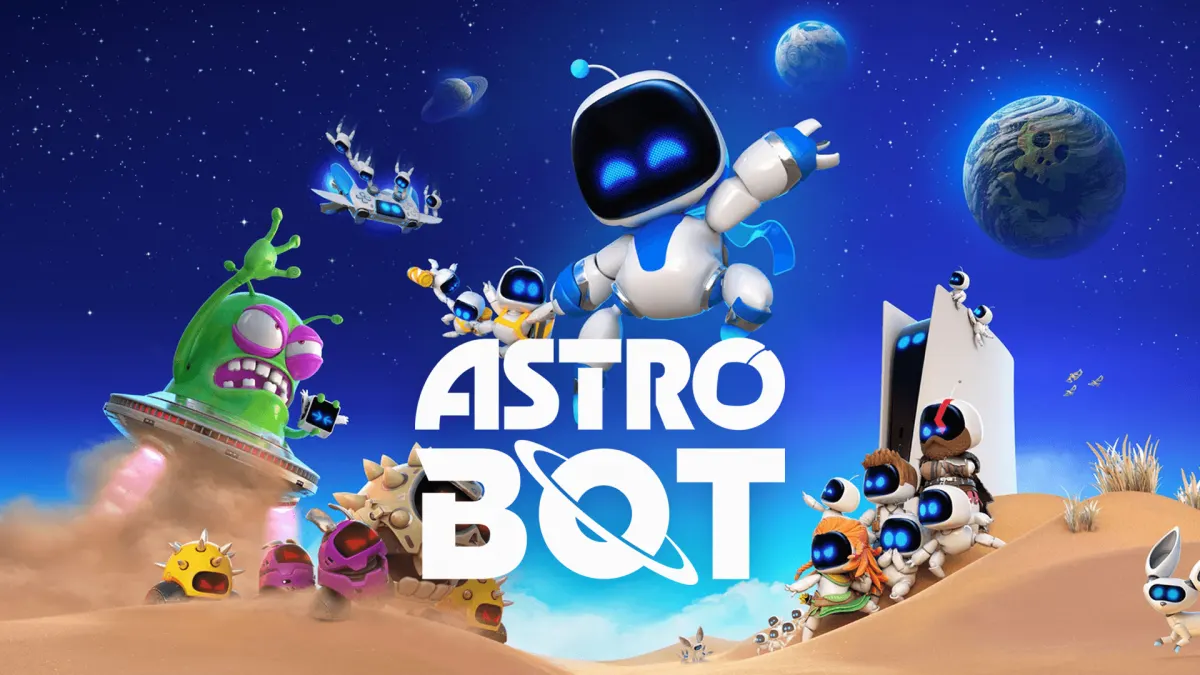
P.S. Don't forget to have fun
The launch of the first PlayStation coincided with the prevalence of a genre in the video game industry: mascot games. Sony's first console unofficially had two mascots that were strongly associated with the brand: Spyro the dragon and Crash Bandicoot. They were a response to Nintendo's monopoly over the industry, as the famous Italian plumber practically represented everything video games stood for. The role of mascots was not only to give a visual identity to the brand, but also to attract new consumers.
The game genres associated with such characters are platformers and the so-called “collectathon”. A platformer is a genre where the player must navigate different levels with precision to overcome various obstacles the developers have placed along the way. Thus, the goal is to get from point A to point B. A collectathon is a genre where different collectible items have been hidden throughout the level, and the goal is to find them all. Collecting all items comes with various rewards, from costumes for the protagonist to special effects or even the famous “passwords”.
As the years passed, more powerful consoles emerged, allowing developers to create other game genres, and gradually platformers and collectathons were abandoned. This is also due to players, as many who first encountered the field in the 90s grew up and changed their tastes. Because the genre became a niche, many video game developers don't venture into creating new titles in this category, as they wouldn't sell well. As proof, the last titles I played in this genre were Crash 4: It’s About Time and Spyro Reignited Trilogy, and the reason was nostalgia.
A new platformer? In this economy?
I was pleasantly surprised by Astro Bot, Team Asobi's new creation. Until the launch of this game, the little robot was a kind of pseudo-mascot for Sony's “new” generation of consoles, namely the PlayStation 5. It is included in the virtual library of everyone who buys this platform through a game called Astro’s Playroom, which serves as a tech demo for the console's various functions and the new controller. The little mascot showed us not only the platform's capabilities but also a brief history of Sony's entertainment brand, showcasing both older models and the various accessories of the famous company from Minato.
The biggest surprise of the wonderful tech demo was the public's reaction to Astro, as he quickly became a beloved character for most users of the PlayStation ecosystem. For this reason, the developer's choice to make a single-player game in the genre that dominated the 90s instead of making Astro a multiplayer game with seasons, microtransactions, and live service elements seems a logical one.
Sony's new exclusive title not only manages to revive this niche but also proves how important passionately made single-player games are. Moreover, Asobi's game manages to celebrate the history of the PlayStation brand along with all the important games that helped the platform become what it is today. As you're used to, we'll start with the story.

The game's premise is simple: Astro's ship, which is a PlayStation 5, is attacked by an alien who steals the console's CPU. Without this component, the robot's “little” ship loses all its functions and crashes on a distant planet in the entertainment universe. Not only did the ship crash, but it also lost almost all its components and crew during the flight, with Astro being the only one who “landed” in the same place as the console. Thus, the little robot's mission is to recover both his ship's components and the lost crew. These must be retrieved from the clutches of various bosses across galaxies under the tyranny of the alien's minions who attacked the ship.
In total, there are six different galaxies in the game, each filled with planets and asteroids that our silent protagonist must explore. At the centre of these six galaxies is also the planet where the ship crashed, a planet that serves as a base where we will bring the rescued robots, who will help us rebuild the PlayStation. These helpers, who serve as collectible items, are of two types:- Simple robots;
- VIP robots.
Those in the first category look just like the protagonist, only they don't wear his magnificent cape. Those in the second category are special, as denoted by their name, namely VIP (Very Important Person). These are robots dressed as characters from the various franchises that helped PlayStation become the entertainment giant it is today.

Thus, I was often surprised to see robots playing the role of characters like Nathan Drake from Uncharted or Kratos from God of War, but I was amazed that Team Asobi wasn't content with just Sony's owned franchises. I was not a little surprised to see robots dressed as Lara Croft, Leon from Resident Evil, or even Rudy Roughknight from Wild Arms. Whether it's a super well-known franchise, like Persona, or more niche, like Ape Escape, everything that helped build the brand's image was included, and some surprises are straight out of PlayStation All-Stars Battle Royale.
Thus, even if the game presents itself as a family game, to enjoy with loved ones and children, its references are not for the general public. I don't think there's a parent who would play a title like Nioh or Onimusha with their kids. However, not only different franchises have become part of the title. Besides recognised characters, we will also encounter robots equipped with various Sony accessories, such as the Lightgun from the PlayStation 3 era or memory cards from the first PlayStation period. The hope of Team Asobi and Sony was that these references would make new players curious about the classic franchises that built the company's reputation, and encourage veteran players to revisit them.

About the levels in general, I can say they are quite short, but their length is not necessarily a negative thing. Most can last 5-10 minutes maximum if you rush through them without doing the secondary objectives (i.e., looking for robots), or 20-30 minutes if you scour every inch and pixel of the area. Each level is a new area, and none are repeated.
Thus, each location is unique, and the enemies we encounter are in theme with the area they are in. For example, there is a planet where we will explore the mysteries of what appears to be an Egyptian temple, where enemies wear pharaonic helmets. When we arrive on the planet with Japanese thermal baths, we will encounter the same enemies, but this time they will wear samurai armour.
Some levels can be solved with Astro's basic abilities, but most will require certain special powers. To give a few examples, the protagonist will have the power to fly horizontally or vertically, to significantly slow down time, or to become an indestructible cannonball. These powers are used in memorable and clever ways, as they are repeated a maximum of 2 times throughout the game. Some of these are used only once, as they wouldn't make sense in other levels, and one particular power is used only in the end credits sequence, which saddened me a bit because it was one of the most fun powers in the entire title.

If the main levels seem too simple, Team Asobi has also prepared some extra challenges for veteran players or those who want more from the game. To obtain all the robots in the game, these additional challenges must be discovered and completed. I can tell you that they are not easy at all. Out of a total of 17 extra challenges, I only managed to complete two on the first try. The rest required 5-6 attempts each, as the difficulty level is high and Astro dies from even the smallest mistake, and the precision you need to demonstrate to complete them is often pixel-perfect.
The final challenge, aptly named Grand Master Challenge, combines all the game's difficult platforming elements into a level that belongs alongside those from the first Crash Bandicoot or classics from the Nintendo Entertainment System such as Battletoads or Ghosts 'n Goblins. To access this final level, all 300 robots must be saved, while only 200 are needed to finish the game's main story. However, for the galaxy boss battles, the player needs a varying number of robots for each.
If the levels are quite simple, and the extra challenges are difficult, the bosses are somewhere in between. Each boss has a unique mechanic that needs to be approached. Although they are memorable in design and combat, these powerful opponents can easily become frustrating. The boss of the third galaxy gave me some headaches and was the fight where I died most often, due to the fact that it wasn't always clear what Astro's correct positioning was to avoid being hit by the snake's tail. After defeating each boss, we will gain access to a special level, where Astro will transform into one of Sony's memorable characters and pay homage to them.
Of all of them, the most interesting is the battle with the alien at the end, as it will take us on a journey through PlayStation's history. Unfortunately, I can't give you more details, but if I were to recommend one thing from the entire game, it would be this fight.

So far I've only talked about the positive aspects of the game, but like any interactive software, it also has some negative aspects. The title incorporates almost all of the DualSense controller's functions, and these can often be annoying. For example, at the beginning of each level, we will “land” on the planet using the controller. This can be controlled not by joysticks, but by physically moving the DualSense from side to side.

Many of Astro's actions will activate the rumble motors in the controller, which will produce vibrations and a fairly loud sound. The haptic feedback function is interesting, but when used to emulate air force when Astro propels himself, it becomes slightly irritating. For players who are parents, who usually have an hour in the evening to play, it's frustrating for the DualSense to vibrate and make noise, as it could wake everyone up. The microphone in the controller is also incorporated into the game, as there are sections that will require the player to blow into the controller to create wind in the game.

Thus, I consider Astro Bot to be one of the best titles of the year, due to its simplicity. The game is easy to get through, but hard to 100% complete, and the homage it pays to PlayStation's history and the partners who helped build the brand's reputation is something unprecedented. In the current market of serious games and live-service creations, Astro Bot is a breath of fresh air that reminds us of yesteryear when games weren't complicated and the goal was to provide the player with a few hours of fun.

Thanks to PlayStation Romania for the opportunity to review this solid 7.

Played on: PS5
Release date: 6 September 2024
Developer: Team Asobi
Publisher: Sony Interactive Entertainment

0 votes
Scroll down here and stay on the page for at least 30 seconds to vote.
Pick a score from 0 to 10 (halves are allowed).